Journals & Research · Journal Article
Judicial Justice and Absolute Justice: Irreversibility, Role-Neutral Accountability, and the Limits of Adjudicative Remedy
Isrg Rajan (Guru Gobind Singh Indraprastha University, New Delhi; Soban Singh Jeena University (State University), Almora, Uttarakhand; Maa Pateswari University, Balrampur, Uttar Pradesh)
Published · Version 1
Abstract
Courts treat justice as done when a procedure concludes: a verdict is delivered, an order is made or compensation is awarded. This article argues that such a declaration records the completion of a procedure, not the realisation of justice. It develops a distinction between two concepts. Judicial Justice is the outcome an adjudicative process produces within rules of evidence, jurisdiction and procedure. Absolute Justice is a role-neutral regulative standard. It accounts for all the harm caused in a matter, including harm the process itself causes, and holds every participant (party, witness, advocate, investigator, adjudicator and institution) to the same measure. The method is conceptual analysis supported by doctrinal illustration, drawn mainly from Indian law with comparative English and United States authority. The article places the distinction alongside: • Rawls's account of imperfect procedural justice; • Sen's contrast between niti and nyaya; • Feeley's finding that the process can itself be the punishment; • the Fiss–Menkel-Meadow debate on settlement; • rule-of-law accounts of official accountability. It then proposes a Restorability Principle: "what cannot be given or reinstated cannot be taken". It applies the principle to wrongful conviction, capital punishment, delay-induced mediation in civil litigation, and maintenance and legal paternity in family law. The article makes three arguments: 1. The gap between Judicial Justice and Absolute Justice is structural. No award can restore the time, health or life lost during a process, so reform can narrow the gap but cannot close it. 2. Read as a graded constraint, the Restorability Principle supports abolishing the death penalty, which Bentham identified as the paradigm of "irremissible" punishment. It still permits reversible or compensable sanctions, subject to heightened justification. 3. Legal systems should formally account for the costs of the process and for the conduct of officials who cause wrongful outcomes. The contribution is a conceptual framework and vocabulary that brings together and extends existing scholarship. The article reports no empirical findings.
Keywords: procedural justice, substantive justice, wrongful conviction, irreversibility, capital punishment, judicial accountability, mediation, maintenance, legal paternity, Indian jurisprudence, Ma'at, dharma
About this article
Article type: Conceptual and doctrinal jurisprudential essay
Jurisdictional focus: India, with comparative reference to England and Wales and the United States
Citation style: OSCOLA (footnotes), with bibliography
First published: Vakil Dial, 17 June 2026, 02:19 IST (16 June 2026, 20:49:56 UTC)
This version: Revised manuscript, 5 November 2026
1. Introduction
1.1 The problem
Suppose a person is convicted of a serious offence and imprisoned. Decades later, the conviction is found to be unsound and the person is released. In formal terms, the legal system has corrected its error: the case is closed and justice is declared to have been done. Yet the years in custody, the damage to health and relationships, and the stigma that outlasts the acquittal have not been restored. At most, they have been partly compensated. The people whose conduct produced the wrongful conviction are rarely held to the standard the system applied to the accused.
This article starts from the intuition that the declaration "justice has been done" is, in such cases, a statement about procedure rather than about justice. The intuition is not new. Rawls classified the criminal trial as the paradigm of imperfect procedural justice, a procedure that aims at a correct outcome but cannot guarantee it.1 Sen distinguished niti (organisational propriety and behavioural correctness) from nyaya (realised justice).2 Feeley showed empirically that in lower criminal courts the pre-trial process can itself be the principal punishment.3 Bentham classified capital punishment as the most perfectly "irremissible" of punishments.4 Existing literature, however, tends to treat these themes separately. Procedural-justice theory concerns the design of procedures. Wrongful-conviction scholarship concerns error and compensation. Death-penalty scholarship concerns irreversibility. Alternative dispute resolution scholarship concerns settlement. No single account explains why these sites share a common defect.
1.2 Research questions
The article addresses three questions:
RQ1. Can a coherent conceptual distinction be drawn between the outcome of adjudication (Judicial Justice) and a role-neutral standard of justice (Absolute Justice)? How does that distinction relate to existing distinctions between formal and substantive justice, and between procedural and outcome-based justice?
RQ2. Which harms does adjudication structurally leave unaccounted for, and why can those harms not be fully remedied within the adjudicative framework?
RQ3. What follows, for capital punishment, civil litigation and family law, from a principle that what cannot be given or reinstated cannot be taken?
1.3 Contribution
The article makes three contributions, which are conceptual and doctrinal rather than empirical:
It offers a vocabulary (Judicial Justice, Absolute Justice and Sarthaq Justice) that names the gap between completed procedure and realised justice. It also places role-neutral accountability at the centre of that gap.
It generalises Bentham's criterion of remissibility into a cross-domain Restorability Principle, and applies the principle beyond the death penalty to civil delay and family law.
It identifies a tension in capital punishment between competency doctrine, which makes a comprehending mind a precondition of trial and execution, and a sanction that ends any further possibility of correction or reinstatement.
The article does not claim that these ideas lack precursors. Section 3 identifies the closest existing work and specifies what is distinctive here.
1.4 Structure
Section 2 sets out the method and scope. Section 3 positions the argument within the literature. Section 4 introduces the guiding principle and defines the key terms. Section 5 develops the central distinction. Section 6 applies it to wrongful conviction. Section 7 states and applies the Restorability Principle. Section 8 considers objections. Sections 9 and 10 set out implications, limitations and directions for further research. Section 11 concludes.
2. Method and Scope
The article uses normative conceptual analysis: it defines concepts, tests them for internal consistency and examines them against counter-examples. This is supported by doctrinal illustration, in which statutes and judicial decisions are read to show how existing law treats the harms in question.
India is the primary jurisdiction. English and United States authorities are used comparatively where they state a principle clearly, for example on judicial immunity, competency to stand trial and the marital presumption of paternity. The comparative material is illustrative, not systematic. The article does not claim that the doctrinal position is identical across jurisdictions.
Indian criminal-procedure and evidence provisions are cited in the form in which the leading cases discuss them, together with their successor provisions. The Code of Criminal Procedure 1973 and the Indian Evidence Act 1872 were replaced, with effect from 1 July 2024, by the Bharatiya Nagarik Suraksha Sanhita 2023 (BNSS) and the Bharatiya Sakshya Adhiniyam 2023 (BSA).5
The article does not present original empirical data. Statements about the frequency or duration of delay, wrongful conviction or settlement pressure are drawn from cited sources or expressly framed as argument. Ancient Egyptian and Indian concepts are used heuristically, as illustrations of a role-neutral standard of judgment. They are not used as historical or theological authority (Section 4.2).
3. Literature and Positioning
3.1 Formal, procedural and substantive justice
Jurisprudence has long distinguished formal justice, the impartial and consistent administration of rules, from the justice of the rules and outcomes themselves. Rawls treats formal justice as "justice as regularity" and separates three kinds of procedural justice:6
In perfect procedural justice, there is an independent criterion of the right outcome and a procedure guaranteed to reach it.
In imperfect procedural justice, there is an independent criterion but no procedure that is sure to reach it.
In pure procedural justice, no independent criterion exists and the fairness of the procedure transfers to the outcome.
Rawls's example of imperfect procedural justice is the criminal trial: "it seems impossible to design the legal rules so that they always lead to the correct result".7
The concept of Judicial Justice developed below builds on Rawls's analysis but differs from it in one respect. Rawls's criterion of a correct outcome is binary: the guilty are convicted and the innocent acquitted. The concept of Absolute Justice adds two further dimensions that a correct verdict does not capture:
the harms the process itself inflicts, whatever the verdict;
the accountability of every participant in the process, including the adjudicator.
A trial that correctly acquits an innocent person after many years in custody is correct in Rawls's sense. It is not just in the sense defended here.
3.2 Niti and nyaya
Sen's distinction between niti, "organizational propriety and behavioural correctness", and nyaya, "a comprehensive concept of realized justice", is the closest existing parallel to the distinction in this article.8 Sen uses it to criticise "transcendental institutionalism", the view that justice consists in identifying perfectly just institutions. He argues instead for comparative assessment of the lives people are actually able to lead.
The present article accepts Sen's emphasis on realised outcomes but departs from him in two ways. First, it applies the distinction to the adjudicative process specifically, rather than to social institutions generally. Second, it advances a role-neutral standard, Absolute Justice, as a regulative ideal against which adjudicative outcomes can be measured. Sen is sceptical of transcendental ideals, so this second step is a deliberate point of difference. Section 8.1 defends it.
3.3 The cost of process
Feeley's study of a lower criminal court found that, for most defendants, the pre-trial process (arrest, detention, repeated appearances, lost work) imposed costs that exceeded any sentence eventually imposed.9 Galanter's analysis of "repeat players" and "one-shotters" showed that the structure of litigation systematically advantages parties who can absorb its costs and delays.10 Pound had earlier identified the inherent limits on what legal action can effectively remedy.11
These works establish empirically and analytically that process costs are real and unevenly distributed. They do not, however, argue that a legal system's claim to have delivered justice must be measured against those costs. That is the step taken here.
3.4 Settlement and its critics
Fiss argued that settlement is "a capitulation to the conditions of mass society", which can reflect imbalances of power and forecloses the public articulation of rights.12 Menkel-Meadow defended settlement "in some cases". She argued that consensual resolution can serve party autonomy and produce better-tailored outcomes than adjudication.13
The argument in Section 7.3 adopts Fiss's critique only for settlement that is induced by delay. It accepts Menkel-Meadow's point that voluntary mediation may be legitimate and valuable.
3.5 Restorative justice and the limits of monetary relief
Restorative-justice scholarship argues that crime is primarily a violation of people and relationships, and that justice requires repairing harm rather than only applying a sanction.14 Braithwaite's theory of reintegrative shaming makes a related point: stigmatising responses can deepen harm.15
These traditions share this article's concern with harms that a verdict leaves unaddressed. They differ in that they seek to repair harm through alternative processes. This article argues that some harms, especially lost time and lost life, cannot be repaired by any process. That is why it treats the gap as structural rather than remediable.
3.6 Accountability of officials and the rule of law
Dicey's conception of the rule of law holds that "every official, from the Prime Minister down to a constable or a collector of taxes, is under the same responsibility for every act done without legal justification as any other citizen".16 Finnis lists, among the features of a legal system that exemplifies the rule of law, that those with authority to "make, administer, and apply the rules in an official capacity" are "accountable for their compliance with rules applicable to their performance".17 Fuller identifies "congruence between official action and declared rule" as one of the conditions without which a system of rules fails to be law.18 At the international level, the United Nations General Assembly has affirmed that "all persons, institutions and entities, public and private, including the State itself, are accountable to just, fair and equitable laws".19
These authorities show that role-neutral accountability is already an established ideal of the rule of law. What Section 5.2 identifies is the gap between that ideal and doctrines, such as judicial and prosecutorial immunity, that limit its application in practice.
3.7 Irreversibility and punishment
Bentham listed remissibility, the capacity of a punishment to be remitted if it is later found to have been undeserved, as a desirable property of punishment. He observed that "the most perfectly irremissible of any is capital punishment".20 In Bachan Singh, the Supreme Court of India upheld the death penalty but confined it to the "rarest of rare" cases.21 The Law Commission of India later relied in part on the fallibility of convictions and the irreversibility of execution in recommending abolition for all crimes other than terrorism-related offences and waging war.22
The irreversibility argument against capital punishment is therefore well established. The contribution of Section 7 is to generalise it into a principle applicable beyond the death penalty, and to connect it with competency doctrine.
3.8 The gap addressed
Taken together, this literature shows that the existing debates (procedural justice, process costs, settlement, restorative justice, official accountability and irreversibility) each address part of the distance between a concluded procedure and realised justice. This article offers a single framework that explains why those parts belong together. It also explains why the remaining gap cannot be wholly closed by procedural reform.
4. Guiding Principle and Terminology
4.1 The guiding principle
The author's guiding principle is:
"Karma and Dharma are the roots of Sarthaq Justice."
-- Isrg Rajan
The Hindi and Sanskrit forms of the principle, with transliteration, appear in Appendix A.
Sarthaq Justice is a term coined by the author. Sarthaq renders the Sanskrit and Hindi sārthaka (सार्थक), "having meaning, significant … serviceable, useful".23 The term was chosen to distinguish what justice ought to be, purposeful and meaningful to those affected, from what adjudication procedurally delivers. Throughout the article, Sarthaq Justice and Absolute Justice refer to the same standard. "Sarthaq Justice" names its purpose (meaningfulness to those affected); "Absolute Justice" names its scope (complete and role-neutral).
4.2 Karma, dharma and Ma'at as heuristic concepts
The terms karma and dharma are used here in a deliberately limited and stipulative sense:
Karma means the principle that every action has consequences for which the actor is accountable, whatever the actor's title or position.
Dharma means the principle that every role, especially a role of authority, carries a duty whose breach is itself an act with consequences.
These stipulated meanings are narrower than the terms' meanings within Indian traditions. Indological scholarship shows that dharma has a complex semantic history, and that both concepts are embedded in specific religious, ritual and legal contexts.24 The article does not claim that the two concepts are identical to Greek logos, Chinese dao or Western natural law, or that every society has independently arrived at them. It claims only that the two stipulated principles, consequence-accountability and role-duty, are widely recognised in moral and legal thought, and that they provide the two criteria Absolute Justice requires.
The ancient Egyptian concept of ma'at (truth, order, justice) is used in the same illustrative way.25 In the Book of the Dead, the vignette accompanying Spell 30B, set within the judgment framework of Spell 125 in the "Hall of the Two Truths", shows the deceased's heart weighed against the feather of Ma'at. Anubis attends the balance, Thoth records the result and Ammit waits to devour a heart that fails.26 In the image, the heart represents the record of the person's conduct, and the feather represents the standard of truth and right order against which that conduct is measured (Figure 1). The image supplies a vivid model of a standard applied to the person's conduct rather than to their office.

Two qualifications are necessary:
The historical practice was less role-neutral than the image suggests. Book of the Dead papyri were costly and were owned mainly by social elites. Heart scarabs inscribed with Spell 30B were designed to prevent the heart from testifying against its owner at the judgment.27 The ideal of an incorruptible weighing therefore coexisted with practices designed to influence it.
The relationship between Ma'at and modern judicial iconography is one of antecedence, not descent. Resnik and Curtis identify the Egyptian Ma'at, together with the Babylonian Shamash, as an early source of the attributes later associated with Justice. They trace the figure's development through the Greek Themis and Dike and the Roman Iustitia. The blindfold appears only in the late fifteenth century, initially as a satirical image.28
The article therefore uses the weighing of the heart as an image of a role-neutral standard. It does not offer the image as evidence that such a standard was historically realised.
5. The Central Distinction: Judicial Justice and Absolute Justice
5.1 Judicial Justice
Judicial Justice is the outcome produced by an adjudicative process. It follows a defined sequence: procedure, trial, verdict and relief (Figure 2).
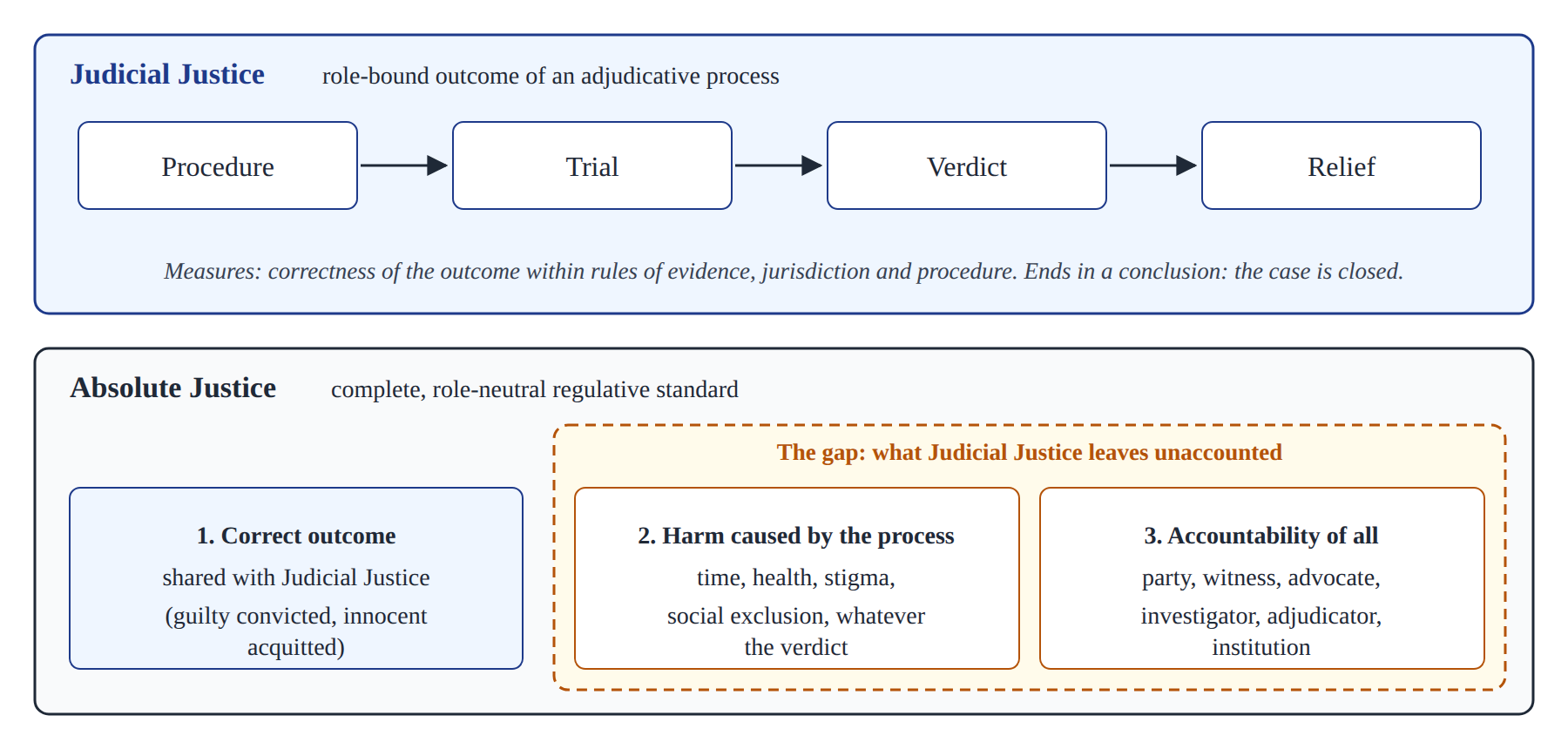
At each stage, it is governed by rules of evidence, jurisdiction, admissibility and procedure.29 It is directed to the case, the matter before the court, and it ends in a conclusion. It is also role-bound. It assigns the participants distinct legal positions (applicant, respondent, witness, advocate and adjudicator) and attaches different rights, duties and immunities to each.
Judicial Justice is structurally incomplete. Its remedial vocabulary cannot fully account for four kinds of harm:
the pain and suffering endured during the process;
the stigma that attaches regardless of the verdict;
the years of life irreversibly consumed by the process;
the social exclusion that may follow even an acquittal.
Some of these harms are partly recognised. Compensation may be awarded for unlawful detention (Section 6), and courts have recognised a right to a speedy trial.30 But these remedies operate as monetary or procedural approximations. A judicial outcome closes a file; it does not restore what the process took.
5.2 Absolute Justice
Absolute Justice is not a legal outcome. It is a regulative standard: a standard against which outcomes can be measured, even though no human institution can fully attain it. It has two defining properties.
Completeness. Absolute Justice accounts for all the harm caused in a matter. This includes harm caused by the process itself and harm suffered before any verdict.
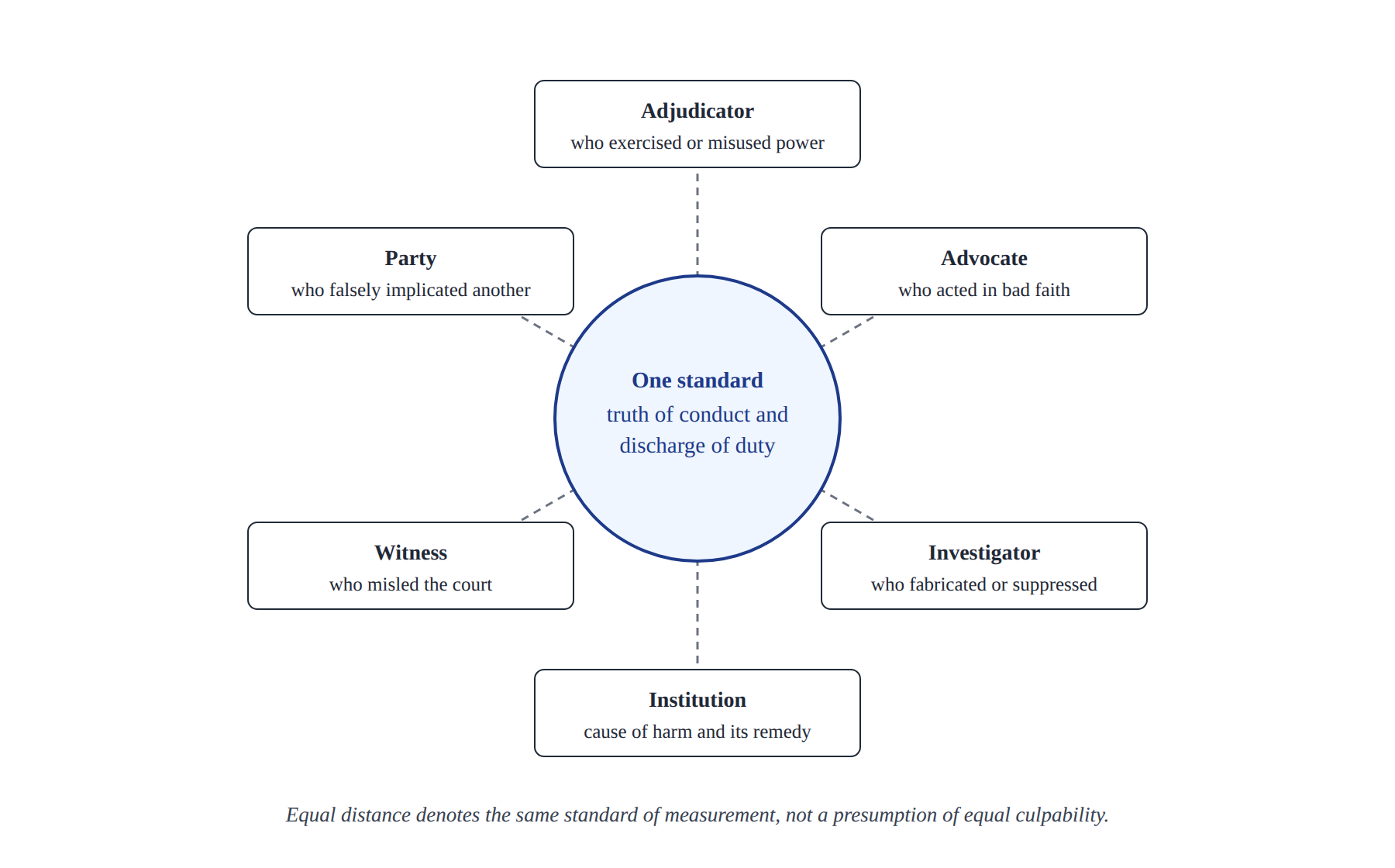
Role-neutrality. Absolute Justice does not treat a person's title (applicant, respondent, advocate or judge) as conferring immunity or a different standing before the standard of truth. It extends accountability to every person whose conduct affected the matter:
the person who falsely implicated another;
the witness who misled the court;
the advocate who acted in bad faith, whose duty to the court ranks above partisan strategy;
the investigator who fabricated or suppressed evidence;
the adjudicator who exercised, or misused, the power of decision;
the institution, which cannot be both the cause of harm and its sole and sufficient remedy.
Role-neutrality must be distinguished from the claim that all participants are equally culpable. Absolute Justice measures each participant against the same standard, the truth of their conduct and the discharge of their duty. It does not presume that each participant has fallen short of it (Figure 3).
The contrast with existing law is clearest in the doctrine of judicial immunity. In the United States, judges are absolutely immune from damages liability for judicial acts, even acts "in error … done maliciously, or … in excess of [their] authority", unless taken in "the clear absence of all jurisdiction".31 Prosecutors are likewise immune for initiating and presenting a prosecution.32 In India, the Judges (Protection) Act 1985 bars civil and criminal proceedings against judges for acts done in the discharge of judicial duty. It preserves, however, the power of governments and superior courts to take civil, criminal, departmental or other action.33
These immunities have a serious justification: they protect judicial independence and the finality of decisions (Section 8.2). The point here is narrower. Rule-of-law theory holds officials accountable for compliance with the rules that govern them (Section 3.6), while immunity doctrine limits the forms that accountability can take. Absolute Justice, as a standard, does not recognise those limits. Judicial Justice, as a practice, must.
5.3 Procedure as handmaid: the law's own acknowledgement
Indian jurisprudence has repeatedly affirmed that procedure exists to serve justice. In Sangram Singh v Election Tribunal, Kotah, Bose J said that a code of procedure is "something designed to facilitate justice and further its ends: not a penal enactment for punishment and penalties; not a thing designed to trip people up".34 In State of Punjab v Shamlal Murari, Krishna Iyer J wrote that "processual law is not to be a tyrant but a servant, not an obstruction but an aid to justice", and that "procedural prescriptions are the handmaid and not the mistress, a lubricant, not a resistant in the administration of justice".35
These statements concede the premise of this article: procedure is instrumental to justice and is not identical with it. They are, however, addressed to the interpretation of procedural rules, telling courts not to let technicalities defeat claims. They do not address the costs that even a correctly applied procedure imposes. In practice, therefore, procedure can become the effective ceiling of what the system delivers, rather than merely the path to justice. The cost of the process in years, dignity, health and social standing is not formally entered into the account of whether justice was done.36
5.4 Legislative clarity and judicial interpretation
The original statement of this doctrine also criticised a system in which well-codified laws are reinterpreted to fit circumstances, "rather than using the law to determine whether the situation fits the law". That criticism has deep roots. Montesquieu described judges as "no more than the mouth that pronounces the words of the law".37 Hamilton described the judiciary as having "neither FORCE nor WILL, but merely judgment", while also affirming that "the interpretation of the laws is the proper and peculiar province of the courts".38 Fuller treated clarity as one of the conditions of legality.39 In Magor and St Mellons RDC v Newport Corporation, Lord Simonds condemned judicial gap-filling as "a naked usurpation of the legislative function under the thin disguise of interpretation".40 The Supreme Court of India has likewise cautioned that "Judges cannot legislate".41
The opposing view must be acknowledged. Hart argued that legal rules, because they are expressed in general language, have an irreducible "open texture", so that some interpretive discretion is unavoidable.42 Lord Denning, in the very line of authority that Lord Simonds rejected, defended the judicial duty to "iron out the creases" in legislation.43 The Supreme Court of India has adopted purposive construction to avoid "manifestly unreasonable and absurd consequences" that a literal reading would produce.44 Under Article 141 of the Constitution of India, the law declared by the Supreme Court binds all courts. Kesavananda Bharati shows how far that interpretive authority extends, reaching to limits on constitutional amendment itself.45
The defensible form of the argument is therefore not that interpretation should be eliminated. It is that reliance on post-enactment interpretation is a symptom of the legislative process failing to achieve clarity, and that each interpretive extension moves the outcome of a case further from a standard the affected person could have known in advance. This strengthens the case for Absolute Justice as a standard. A person cannot be fully accountable to a rule whose meaning is settled only after the conduct in question, and a system that settles meaning in this way cannot claim that its outcome was fully just.
6. Wrongful Conviction: An Illustrative Case
A person is charged under a serious penal provision and imprisoned. After thirty to forty years, the judicial system finds the conviction was not valid. To uphold justice, the person is released. The release may sound as justice, but the sacrifice was never counted. Financial assistance cannot restore what was taken.
-- Isrg Rajan
This hypothetical is an illustrative thought experiment. It does not prove the distinction, but it isolates it clearly. Garrett's study of DNA exonerations in the United States documents how wrongful convictions arise from false confessions, flawed forensic evidence, mistaken eyewitness identification and informant testimony. It also documents how long exonerees had already spent in prison.46 In India, Rudul Sah v State of Bihar concerned a man who remained in prison for more than fourteen years after his acquittal. The Supreme Court awarded compensation under Article 32 because, without it, the Court's recognition of his right to liberty would be "mere lip-service".47 The Court later held, in Nilabati Behera, that compensation for breach of fundamental rights is a public-law remedy based on strict liability.48
Under Judicial Justice, release, together with any compensation, is the remedy, and the case is closed. Under Absolute Justice, the following remain unaccounted for:
Table 1. What wrongful conviction takes and what existing remedies provide
Harm suffered | Remedy available under Judicial Justice |
|---|---|
Years of liberty and life | None restorative; release ends further loss only |
Mental and physical health | Monetary compensation, where available |
Social identity and relationships | No direct remedy |
Professional and financial life | Monetary compensation, where available and often partial |
Stigma persisting after release | No direct remedy |
Accountability of those who caused the wrongful conviction | Limited: perjury and fabrication offences, disciplinary proceedings and tort actions exist but are constrained by immunities and rarely invoked |
The availability of compensation varies by jurisdiction:
ICCPR. Article 14(6) of the International Covenant on Civil and Political Rights requires compensation "according to law" where a conviction is reversed on the ground of a newly discovered fact showing a miscarriage of justice.49
England and Wales. Section 133 of the Criminal Justice Act 1988 provides a statutory scheme. Since 2014, however, it applies only where the new fact shows beyond reasonable doubt that the person did not commit the offence, and the awards are capped.50
India. The Law Commission of India, in Report No 277 (2018), recommended a specific statutory framework for compensating victims of wrongful prosecution, with special courts and guiding principles for both monetary and non-monetary relief.51
These developments show the law recognising the problem. They also illustrate the article's thesis: each remedy is an approximation in money, and none restores the time taken.
The people whose conduct produced the wrongful outcome (the person who falsely implicated, the investigator who fabricated, the witness who misled) can in principle be prosecuted for fabricating or giving false evidence.52 The adjudicator who convicted on insufficient evidence is, in damages, protected by immunity. They are not placed before the same standard they applied. That asymmetry is the point at which Judicial Justice and Absolute Justice diverge.
A system that exempts itself from its own standard has not delivered justice; it has delivered a conclusion.
7. The Restorability Principle: "What Cannot Be Given or Reinstated Cannot Be Taken"
"What cannot be given or reinstated cannot be taken."
-- Isrg Rajan
7.1 Statement and interpretation
This principle follows from the distinction between Judicial Justice and Absolute Justice. It operates as a test of the legitimacy of any punitive measure, relief or judicial outcome: the power to take must be bounded by the capacity to account for what the taking irreversibly destroys.
Read literally and absolutely, the principle would prohibit any sanction that cannot be fully undone. That would include imprisonment, since time served cannot be returned. Yet this article accepts that punishment, including imprisonment, is a legitimate and necessary function of penal law (Section 7.2). To avoid that contradiction, the principle is stated here in a graded form:
Restorability Principle. The justification required for a coercive measure increases with the degree to which its effects are irreversible and uncompensable. A measure that forecloses all possibility of later correction, reinstatement or compensation to the person affected cannot be justified under Absolute Justice.
On this reading, sanctions fall into three classes:
Fully remissible sanctions, such as fines, can be returned in full.
Partly remissible sanctions, such as imprisonment, can be ended on the discovery of error and partly compensated, but not fully restored. They demand heightened justification, timely review and compensation for error.
Wholly irremissible sanctions, such as execution, foreclose any correction. They fail the principle.
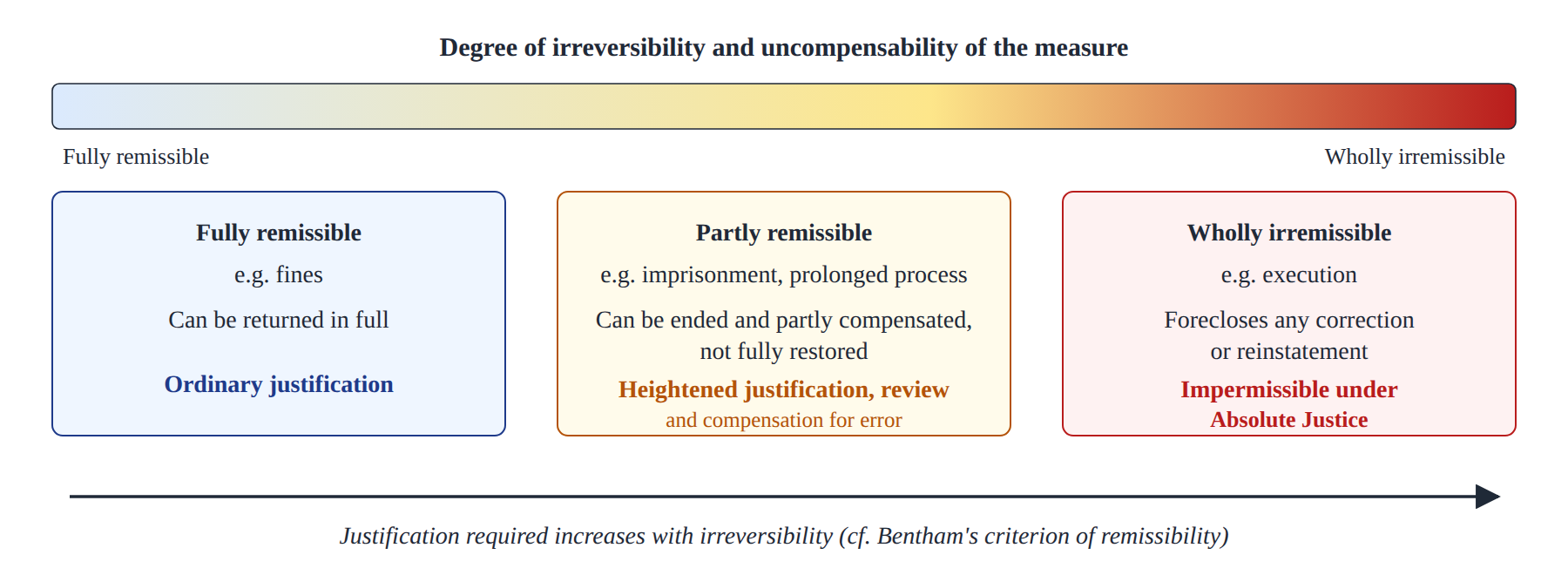
This mirrors Bentham's graduated treatment of remissibility as a property that punishments possess in varying degrees.53 It extends that analysis by treating the irreversible costs of process, not only of sentence, as falling within the principle.
7.2 Capital punishment: the mind, not the body, commits a crime
The mind as the seat of culpability. Criminal law locates culpability primarily in the mind. The maxim actus non facit reum nisi mens sit rea (an act does not make a person guilty unless the mind is also guilty) expresses the principle. English authority requires, for many serious offences, proof of a subjective mental state.54 Hart's account of responsibility makes liability depend on a person's "normal capacities, physical and mental", and a "fair opportunity to exercise these capacities".55
The competency requirement. The criminal process makes mental competence a condition of its operation:
A person must be fit to stand trial. In English law this is the Pritchard test, and in the United States the Dusky standard of "a rational as well as factual understanding of the proceedings".56
In India, the BNSS (formerly sections 328 and 329 of the Code of Criminal Procedure 1973) prescribes the procedure where an accused appears to be of unsound mind.57
The requirement extends to the moment of execution. The United States Supreme Court has held that the Eighth Amendment prohibits the execution of a prisoner who lacks a rational understanding of the reason for execution.58
The Supreme Court of India has held that post-conviction severe mental illness is a mitigating factor that may warrant commutation of a death sentence.59 It has also treated insanity or mental illness as a supervening circumstance relevant to commutation.60
The tension. These doctrines show that the legal system treats a comprehending mind as the proper subject of justice, at trial and even at execution. Capital punishment, however, acts on the body and ends the person entirely. It does not correct, reform or render the mind accountable in any continuing sense. Above all, it removes any possibility that a later-discovered error could be remedied for the person affected.
The original form of this argument claimed that these positions are "irreconcilable". That claim should be stated more precisely. Competency-to-be-executed doctrine is the law's attempt to reconcile them: it permits execution only of a person who understands why they are being executed. The law can therefore claim consistency at the level of conditions. The tension remains at the level of effect. The system requires a comprehending mind as the justification for the sanction, yet the sanction eliminates the subject whose comprehension justified it, together with any possibility of correction. Combined with the fallibility of convictions (Section 6), this supports the conclusion that the death penalty fails the Restorability Principle.
Two qualifications.
The argument does not rest on mind–body dualism. Criminal law attributes responsibility to persons, not to minds separated from bodies, and liability without proof of fault (strict liability) exists for some offences. The claim is that the justification for punishment depends on the person's mental capacities, and that a sanction which ends the person entirely is uniquely incapable of correction.
The argument does not deny that punishment is a vital function of a legal system. Accountability, deterrence and the protection of society are legitimate aims of penal law. The claim is only that death, as a form of punishment, cannot be justified under Absolute Justice. This conclusion converges with the Law Commission of India's recommendation of abolition (subject to its exceptions for terrorism-related offences and waging war),61 although it is reached by a different route.
7.3 Civil justice: from adjudication to induced mediation
The Restorability Principle applies to civil disputes as well. Here, the irreversible taking occurs gradually, through years of delay, rather than in a single act. Delay and arrears in Indian courts have been examined repeatedly by the Law Commission of India.62 The World Justice Project treats freedom from "unreasonable delay" as a distinct component of civil justice in its Rule of Law Index.63 A common trajectory, which the article presents as an analytical model rather than an empirical finding, runs from dispute to filing, prolonged hearing, procedural delay, settlement pressure and finally mediation (Figure 5).
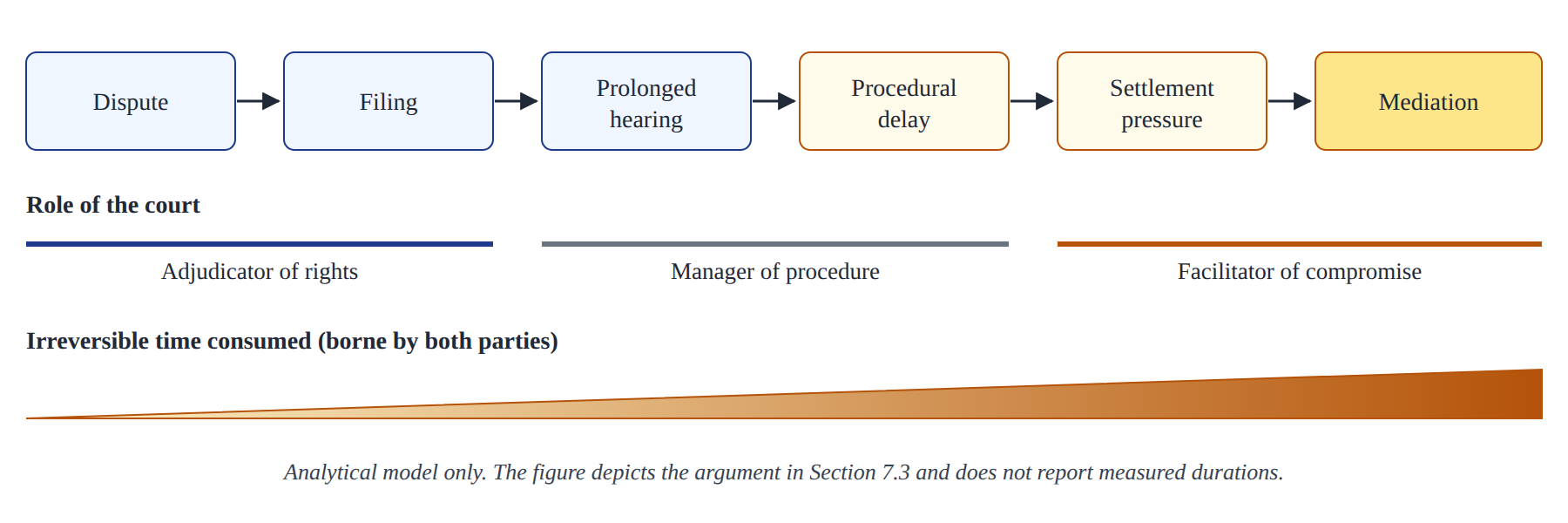
Indian law encourages alternative dispute resolution in several ways:
Section 89 of the Code of Civil Procedure 1908 requires courts to consider referring disputes to alternative dispute resolution. In Afcons Infrastructure, the Supreme Court held that consideration of such a reference is mandatory outside excluded categories.64
The Mediation Act 2023 makes pre-litigation mediation voluntary.65
For commercial disputes of specified value, section 12A of the Commercial Courts Act 2015 requires pre-institution mediation where no urgent interim relief is sought. Patil Automation held that requirement to be mandatory.66
Voluntary mediation, chosen by parties who genuinely seek a negotiated outcome, can be legitimate and valuable, as Menkel-Meadow argues.67 The concern here is narrower. Where acceptance of a settlement is driven by systemic delay, procedural exhaustion and the court's inability to deliver a timely adjudicated outcome, the settlement is not fully consensual. Its terms may reflect the parties' differing capacity to endure delay rather than the merits of their claims. Galanter's analysis predicts this, and it lies at the core of Fiss's critique.68
In such cases, the court's role shifts in two stages. It moves first from adjudicator of rights to manager of procedure. It then moves, under the pressure of its own backlog, to facilitator of compromise. To the extent that this happens, delay-induced mediation is better described as an acknowledgement of adjudicative failure than as a form of justice. The years consumed before settlement are taken from both parties and cannot be reinstated. Under the Restorability Principle, they count against any claim that justice was done.
7.4 The family court: what the judicial lens cannot see
Maintenance. Family law illustrates the gap with particular clarity. Courts may order one spouse to pay maintenance to the other. Under section 125 of the Code of Criminal Procedure 1973, now section 144 of the BNSS, the obligation runs from husband to wife (as well as to children and parents). Under sections 24 and 25 of the Hindu Marriage Act 1955, either spouse may be ordered to pay.69 The Supreme Court has extended the reach of maintenance law, notably in Shah Bano.70 In Rajnesh v Neha, it issued detailed guidelines, including mandatory disclosure of assets and liabilities and the payment of maintenance from the date of application.71
These developments are significant, but they confirm the structural point. The years spent in litigation are years in which both parties' lives are suspended. For a dependent spouse, this period may coincide with time-sensitive life decisions about work, residence, relationships and, for some, family formation. A monetary order, however well calibrated, cannot restore that time. For the paying spouse, the order is an ongoing obligation. It may carry social stigma and does not address the circumstances of the separation. Neither party receives Absolute Justice; both receive the conclusion of a procedure.
Legal and biological paternity. The same gap appears in the law of paternity. Section 112 of the Indian Evidence Act 1872, now section 116 of the BSA, provides that birth during a valid marriage, or within 280 days after its dissolution while the mother remains unmarried, is "conclusive proof" of legitimacy, "unless it can be shown that the parties to the marriage had no access to each other" at the relevant time.72 In Michael H v Gerald D, a plurality of the United States Supreme Court upheld a conclusive marital presumption against the claims of the biological father.73
Indian courts have taken divergent positions on the role of scientific evidence:
In Goutam Kundu, the Supreme Court held that blood tests cannot be ordered "as a matter of course".74
In Nandlal Wasudeo Badwaik, it held that where DNA evidence conflicts with the statutory presumption, "the latter must prevail over the former". It relieved the husband of the obligation to maintain a child shown not to be his.75
In Ivan Rathinam v Milan Joseph (2025), the Court reaffirmed that "legitimacy determines paternity" under section 112 until the presumption is rebutted by proof of non-access. It required a strong case and a balancing of privacy and dignity before a DNA test can be ordered.76
The presumption of legitimacy serves important interests, especially the child's interest in status, support and dignity, and the article takes no position on how those interests should be balanced. Its point is structural. The law can impose financial and legal responsibility on the basis of a legal status that may not correspond to biological fact, and whether biological fact can be established depends on procedural thresholds. Whatever balance is struck, the outcome is a procedural determination of status. It is not an accounting of truth in the sense Absolute Justice requires.
7.5 The award as procedure: relief without restoration
In the present legal order, an award, whether relief, compensation, acquittal or order, marks the end of a case. It does not mark the restoration of what was lost, the accounting of what was taken, or the application of an equal standard to all who participated in the matter. It is the system's declaration that it has completed its function.
This distinction between the completion of a procedure and the delivery of justice is the central claim of the article. Judicial Justice is the completion of a procedure; Absolute Justice is the standard against which that completion must be measured. Reform can narrow the gap between them: faster adjudication, compensation for wrongful prosecution, accountability for those who fabricate evidence and the abolition of irremissible punishment would each do so. Reform cannot close the gap entirely, because what the process consumes (time, health and in the extreme case life) cannot be restored by any award. The gap is in this sense structural, and it should be named as such.
What cannot be given or reinstated cannot be taken. The judicial system routinely takes what it cannot restore, including years, health and irreversible time, and it calls the resulting procedure justice.
8. Objections and Replies
8.1 "Absolute Justice is unattainable and therefore useless"
Sen argues that identifying a perfectly just state of affairs is neither necessary nor sufficient for comparative judgments about justice.77 The objection has force against any claim that institutions should be designed to achieve Absolute Justice. The article makes no such claim. Absolute Justice functions as a regulative standard. It identifies what an outcome fails to account for, and so allows comparative judgments: an outcome that compensates process costs and holds fabricators accountable is more just than one that does neither. In this respect the standard supports the kind of comparative assessment Sen favours.
8.2 "Immunity is necessary for judicial independence"
Judicial immunity protects judges from vexatious litigation by disappointed parties and preserves the independence of decision-making. These are serious values, and the article does not argue for abolishing immunity from personal damages. It argues that immunity limits the forms of accountability, and that a legal system which relies on immunity should, as a matter of consistency, provide other channels for accounting for wrongful outcomes, such as institutional compensation, review and disciplinary mechanisms. Indian law already preserves such channels.78
8.3 "The incompleteness of remedies is a reason for reform, not a structural flaw"
Many harms identified here can be reduced by reform, and Section 9 recommends reforms. The irreversibility of time, however, is not a defect of any particular procedure. It is a feature of every process that takes time. However efficient adjudication becomes, it consumes some portion of the lives of those subject to it, and that portion cannot be returned. The structural claim is limited to this irreducible residue.
8.4 "The use of karma, dharma and Ma'at is culturally partial"
The article uses these concepts heuristically and stipulatively (Section 4.2), and its arguments do not depend on them. Each step can be restated in secular terms: consequence-accountability, role-duty and a role-neutral standard of judgment. The concepts are retained because they express the intuition behind the argument concisely and because they belong to the intellectual tradition from which the author writes.
9. Implications and Recommendations
The following recommendations follow from the analysis. They are normative proposals, not empirically tested policies.
Statutory compensation for wrongful prosecution in India. The framework recommended by the Law Commission of India in Report No 277 should be enacted. Compensation should expressly include non-monetary support, such as counselling, rehabilitation and the expunging of records, in recognition that monetary relief alone is an approximation.
Formal recognition of process costs. Where proceedings end in acquittal, discharge or withdrawal after prolonged detention or delay, courts and legislatures should consider mechanisms that formally record and, where appropriate, compensate the costs of the process itself.
Accountability for those who cause wrongful outcomes. Existing offences of fabricating and giving false evidence, and disciplinary mechanisms for investigators and advocates, should be applied consistently where wrongful outcomes are traced to such conduct.
Safeguards against delay-induced settlement. Courts referring disputes to mediation should satisfy themselves that consent is genuine. The availability of timely adjudication should be treated as a precondition of legitimate mediation, not a substitute for it.
Abolition of the death penalty. Consistently with the Restorability Principle, and with the Law Commission of India's Report No 262, the death penalty should be abolished.
Legislative clarity. Legislatures should invest in pre-enactment scrutiny and clear drafting, so as to reduce reliance on post-enactment judicial interpretation.
10. Limitations and Future Research
10.1 Limitations
No empirical testing. The analysis is conceptual and doctrinal. It does not measure the frequency or magnitude of the harms it describes, the incidence of wrongful conviction in India, or the extent to which settlements are induced by delay.
Selective comparative coverage. Doctrinal illustrations are drawn mainly from India, with selective English and United States comparison, and other legal systems may treat these issues differently.
Stipulated concepts. The concepts of karma, dharma and Ma'at are used in a stipulated, heuristic sense and do not engage their full traditional meanings.
A regulative standard. Absolute Justice is a regulative standard. The article does not provide an operational metric for measuring the gap between it and Judicial Justice in a particular case.
10.2 Future research
Empirical study. Researchers could study the duration and costs of process borne by acquitted accused persons and by civil litigants in India, building on the methods of Feeley and Galanter.
Comparative analysis. Statutory compensation schemes for wrongful conviction could be compared against the Restorability Principle.
Operational criteria. Criteria could be developed for distinguishing voluntary from delay-induced consent to mediation.
Children's interests. Further work could analyse how the Restorability Principle interacts with children's interests in paternity and legitimacy disputes.
11. Conclusion
This article has argued for a distinction between Judicial Justice and Absolute Justice (RQ1).
Judicial Justice is the outcome of a role-bound adjudicative procedure.
Absolute Justice is a complete and role-neutral standard that accounts for all harm caused in a matter and holds all participants to the same measure.
The distinction refines Rawls's account of imperfect procedural justice and parallels Sen's contrast between niti and nyaya. It adds two dimensions that a correct verdict does not capture: the costs of process and the accountability of all participants.
Adjudication structurally leaves unaccounted for the time, health, relationships and social standing consumed by the process, as well as the conduct of the officials whose actions produced a wrongful outcome (RQ2). Some of these harms can be reduced by reform. The irreversibility of time cannot be undone by any award, so the gap is structural.
The article has proposed a Restorability Principle, "what cannot be given or reinstated cannot be taken", read as a graded constraint (RQ3). Applied to capital punishment, the principle supports abolition. Applied to civil litigation, it shows why mediation induced by delay should not be treated as justice. Applied to family law, it shows that maintenance orders and paternity determinations are procedural approximations that cannot account for the lives they affect.
The contribution is a framework and vocabulary, not empirical proof. It invites further empirical and comparative work on the costs of process and on remedies for wrongful outcomes.
Author's Note on Prior Publication
An earlier version of this work was first published by the author on Vakil Dial on 17 June 2026 at 02:19 IST (16 June 2026, 20:49:56 UTC). Vakil Dial is identified by the author as a platform that shares the open, access-oriented approach to legal knowledge reflected in this work. The concepts of Judicial Justice, Absolute Justice and Sarthaq Justice, the Restorability Principle as formulated here, and the guiding quotations are the author's own. Where this article draws on, or converges with, earlier scholarship, that scholarship is acknowledged in the footnotes.
Declarations
Authorship: Isrg Rajan (Isrgrajan Gonardiya; ORCID 0000-0001-6496-4480) is the sole author.
Affiliations: Guru Gobind Singh Indraprastha University; Soban Singh Jeena University (State University); Maa Pateswari University.
Ethics: This study did not involve human participants, personal data or animals.
Data availability: No datasets were generated or analysed. All sources are cited in the footnotes and bibliography.
Appendix A: The Guiding Principle in Hindi and Sanskrit
English: "Karma and Dharma are the roots of Sarthaq Justice."
Sanskrit, as originally authored:
कर्म च धर्मस्य, सार्थक न्यायस्य निदानम्
karma ca dharmasya, sārthaka nyāyasya nidānam
Hindi:
कर्म तथा धर्म, सार्थक न्याय के निदान हैं।
karm tathā dharm, sārthak nyāy ke nidān haiṁ
Editorial note on the Sanskrit form. In the original line, dharmasya is in the genitive case and so cannot be coordinated with karma by ca, and sārthaka stands as an uninflected stem. A grammatically regularised rendering, offered for the author's consideration, is:
कर्मधर्मौ सार्थकन्यायस्य निदानम्
karmadharmau sārthakanyāyasya nidānam
In this rendering, a dual compound ("karma and dharma") is the subject. The predicate noun nidānam ("primary cause, root") may keep its own number, a construction recognised in classical Sanskrit syntax.79 Nidāna means "a first or primary cause"; in modern Hindi, nidān commonly means "diagnosis", so readers may take the Hindi line in that sense.80
Notes
- John Rawls, A Theory of Justice (Belknap Press of Harvard University Press 1971) §14.
- Amartya Sen, The Idea of Justice (Allen Lane 2009) Introduction.
- Malcolm M Feeley, The Process Is the Punishment: Handling Cases in a Lower Criminal Court (Russell Sage Foundation 1979).
- Jeremy Bentham, An Introduction to the Principles of Morals and Legislation (first published 1789) ch XV; Jeremy Bentham, The Rationale of Punishment (Robert Heward 1830) bk I ch VII.
- Bharatiya Nagarik Suraksha Sanhita 2023 (Act 46 of 2023); Bharatiya Sakshya Adhiniyam 2023 (Act 47 of 2023). Both in force from 1 July 2024.
- Rawls (n 1) §§10, 14.
- ibid §14.
- Sen (n 2) Introduction.
- Feeley (n 3).
- Marc Galanter, 'Why the "Haves" Come Out Ahead: Speculations on the Limits of Legal Change' (1974) 9 Law & Society Review 95.
- Roscoe Pound, 'The Limits of Effective Legal Action' (1917) 27 International Journal of Ethics 150.
- Owen M Fiss, 'Against Settlement' (1984) 93 Yale Law Journal 1073.
- Carrie Menkel-Meadow, 'Whose Dispute Is It Anyway? A Philosophical and Democratic Defense of Settlement (In Some Cases)' (1995) 83 Georgetown Law Journal 2663.
- Howard Zehr, Changing Lenses: A New Focus for Crime and Justice (Herald Press 1990).
- John Braithwaite, Crime, Shame and Reintegration (Cambridge University Press 1989).
- AV Dicey, Introduction to the Study of the Law of the Constitution (8th edn, Macmillan 1915) 189.
- John Finnis, Natural Law and Natural Rights (Clarendon Press 1980) 270–71.
- Lon L Fuller, The Morality of Law (rev edn, Yale University Press 1969) ch 2.
- UNGA Res 67/1 (24 September 2012) UN Doc A/RES/67/1, para 2. A related definition of the rule of law, requiring laws that are "publicly promulgated, equally enforced and independently adjudicated", appears in UNSC, 'The Rule of Law and Transitional Justice in Conflict and Post-Conflict Societies: Report of the Secretary-General' (23 August 2004) UN Doc S/2004/616, para 6.
- Bentham, Rationale of Punishment (n 4) bk I ch VII; see also bk II ch XII ("For death there is no remedy").
- Bachan Singh v State of Punjab (1980) 2 SCC 684.
- Law Commission of India, The Death Penalty (Report No 262, August 2015) para 7.2.4; see also paras 2.4.15, 5.2.54.
- Monier Monier-Williams, A Sanskrit-English Dictionary (Clarendon Press 1899) 1209, s.v. sārthaka.
- Patrick Olivelle, 'The Semantic History of Dharma: The Middle and Late Vedic Periods' (2004) 32 Journal of Indian Philosophy 491; Patrick Olivelle (ed), Dharma: Studies in Its Semantic, Cultural and Religious History (Motilal Banarsidass 2009); Donald R Davis Jr, The Spirit of Hindu Law (Cambridge University Press 2010); Wendy Doniger O'Flaherty (ed), Karma and Rebirth in Classical Indian Traditions (University of California Press 1980).
- Jan Assmann, Ma'at: Gerechtigkeit und Unsterblichkeit im Alten Ägypten (CH Beck 1990).
- EA Wallis Budge, The Book of the Dead: The Papyrus of Ani in the British Museum (printed by order of the Trustees of the British Museum 1895); Miriam Lichtheim, Ancient Egyptian Literature, Vol II: The New Kingdom (University of California Press 1976) (Spell 125); John H Taylor (ed), Journey through the Afterlife: Ancient Egyptian Book of the Dead (British Museum Press 2010).
- Taylor (n 26).
- Judith Resnik and Dennis E Curtis, 'Representing Justice: From Renaissance Iconography to Twenty-First-Century Courthouses' (2007) 151 Proceedings of the American Philosophical Society 139, 144, 160–63; see generally Judith Resnik and Dennis Curtis, Representing Justice: Invention, Controversy, and Rights in City-States and Democratic Courtrooms (Yale University Press 2011).
- For the classical common-law account of pleading, trial and evidence, see William Blackstone, Commentaries on the Laws of England, bk III (Clarendon Press 1768) chs 20–23.
- Hussainara Khatoon v Home Secretary, State of Bihar AIR 1979 SC 1360, (1980) 1 SCC 81.
- Stump v Sparkman 435 US 349 (1978); Pierson v Ray 386 US 547 (1967).
- Imbler v Pachtman 424 US 409 (1976).
- Judges (Protection) Act 1985, s 3; see also Judicial Officers' Protection Act 1850, s 1.
- Sangram Singh v Election Tribunal, Kotah AIR 1955 SC 425.
- State of Punjab v Shamlal Murari (1976) 1 SCC 719; see also Sushil Kumar Sen v State of Bihar (1975) 1 SCC 774 (Krishna Iyer J, concurring); Shreenath v Rajesh (1998) 4 SCC 543 ("procedural law is always subservient to and is in aid to justice").
- Feeley (n 3); Galanter (n 10).
- Montesquieu, The Spirit of Laws (first published 1748, Thomas Nugent tr) bk XI ch 6.
- Alexander Hamilton, 'The Federalist No 78' (1788).
- Fuller (n 18) ch 2.
- Magor and St Mellons RDC v Newport Corporation [1952] AC 189 (HL) (Lord Simonds).
- Divisional Manager, Aravali Golf Club v Chander Hass (2008) 1 SCC 683.
- HLA Hart, The Concept of Law (Clarendon Press 1961) ch VII.
- Seaford Court Estates Ltd v Asher [1949] 2 KB 481 (CA) (Denning LJ); Lord Denning, The Discipline of Law (Butterworths 1979).
- KP Varghese v Income Tax Officer (1981) 4 SCC 173.
- Constitution of India, art 141; Kesavananda Bharati v State of Kerala (1973) 4 SCC 225.
- Brandon L Garrett, Convicting the Innocent: Where Criminal Prosecutions Go Wrong (Harvard University Press 2011).
- Rudul Sah v State of Bihar (1983) 4 SCC 141, AIR 1983 SC 1086.
- Nilabati Behera v State of Orissa (1993) 2 SCC 746.
- International Covenant on Civil and Political Rights (adopted 16 December 1966, entered into force 23 March 1976) 999 UNTS 171, art 14(6).
- Criminal Justice Act 1988, s 133, as amended by the Anti-social Behaviour, Crime and Policing Act 2014 (s 133(1ZA)).
- Law Commission of India, Wrongful Prosecution (Miscarriage of Justice): Legal Remedies (Report No 277, August 2018).
- Indian Penal Code 1860, ss 191–193; now Bharatiya Nyaya Sanhita 2023, ss 227–229.
- Bentham, Principles of Morals and Legislation (n 4) ch XV.
- R v Cunningham [1957] 2 QB 396; DPP v Morgan [1976] AC 182 (HL). The rule in Morgan on mistaken belief in consent has since been displaced in England and Wales by the Sexual Offences Act 2003.
- HLA Hart, Punishment and Responsibility: Essays in the Philosophy of Law (Clarendon Press 1968).
- R v Pritchard (1836) 7 C & P 303; Dusky v United States 362 US 402 (1960).
- Code of Criminal Procedure 1973, ss 328–329; now Bharatiya Nagarik Suraksha Sanhita 2023, ss 367–368.
- Ford v Wainwright 477 US 399 (1986); Panetti v Quarterman 551 US 930 (2007); Madison v Alabama 586 US 265 (2019).
- Accused 'X' v State of Maharashtra (2019) 7 SCC 1.
- Shatrughan Chauhan v Union of India (2014) 3 SCC 1.
- Law Commission of India, Report No 262 (n 22) para 7.2.4.
- Law Commission of India, Arrears and Backlog: Creating Additional Judicial (wo)manpower (Report No 245, July 2014).
- World Justice Project, Rule of Law Index, Factor 7 (Civil Justice), sub-factor 7.5 ("Civil justice is not subject to unreasonable delay").
- Code of Civil Procedure 1908, s 89; Afcons Infrastructure Ltd v Cherian Varkey Construction Co (P) Ltd (2010) 8 SCC 24.
- Mediation Act 2023 (Act 32 of 2023), s 5(1).
- Commercial Courts Act 2015, s 12A; Patil Automation (P) Ltd v Rakheja Engineers (P) Ltd (2022) 10 SCC 1.
- Menkel-Meadow (n 13).
- Galanter (n 10); Fiss (n 12).
- Code of Criminal Procedure 1973, s 125; now Bharatiya Nagarik Suraksha Sanhita 2023, s 144; Hindu Marriage Act 1955, ss 24–25.
- Mohd Ahmed Khan v Shah Bano Begum (1985) 2 SCC 556.
- Rajnesh v Neha (2021) 2 SCC 324.
- Indian Evidence Act 1872, s 112; now Bharatiya Sakshya Adhiniyam 2023, s 116.
- Michael H v Gerald D 491 US 110 (1989).
- Goutam Kundu v State of West Bengal (1993) 3 SCC 418.
- Nandlal Wasudeo Badwaik v Lata Nandlal Badwaik (2014) 2 SCC 576.
- Ivan Rathinam v Milan Joseph 2025 INSC 115.
- Sen (n 2).
- Judges (Protection) Act 1985, s 3(2); Constitution of India, art 124(4).
- JS Speijer, Sanskrit Syntax (EJ Brill 1886) §27.
- Monier-Williams (n 23) 548, s.v. nidāna.
Bibliography
Cases
India
Accused 'X' v State of Maharashtra (2019) 7 SCC 1
Afcons Infrastructure Ltd v Cherian Varkey Construction Co (P) Ltd (2010) 8 SCC 24
Bachan Singh v State of Punjab (1980) 2 SCC 684
Divisional Manager, Aravali Golf Club v Chander Hass (2008) 1 SCC 683
Goutam Kundu v State of West Bengal (1993) 3 SCC 418
Hussainara Khatoon v Home Secretary, State of Bihar AIR 1979 SC 1360
Ivan Rathinam v Milan Joseph 2025 INSC 115
Kesavananda Bharati v State of Kerala (1973) 4 SCC 225
KP Varghese v Income Tax Officer (1981) 4 SCC 173
Mohd Ahmed Khan v Shah Bano Begum (1985) 2 SCC 556
Nandlal Wasudeo Badwaik v Lata Nandlal Badwaik (2014) 2 SCC 576
Nilabati Behera v State of Orissa (1993) 2 SCC 746
Patil Automation (P) Ltd v Rakheja Engineers (P) Ltd (2022) 10 SCC 1
Rajnesh v Neha (2021) 2 SCC 324
Rudul Sah v State of Bihar (1983) 4 SCC 141
Sangram Singh v Election Tribunal, Kotah AIR 1955 SC 425
Shatrughan Chauhan v Union of India (2014) 3 SCC 1
Shreenath v Rajesh (1998) 4 SCC 543
State of Punjab v Shamlal Murari (1976) 1 SCC 719
Sushil Kumar Sen v State of Bihar (1975) 1 SCC 774
England and Wales
DPP v Morgan [1976] AC 182 (HL)
Magor and St Mellons RDC v Newport Corporation [1952] AC 189 (HL)
R v Cunningham [1957] 2 QB 396
R v Pritchard (1836) 7 C & P 303
Seaford Court Estates Ltd v Asher [1949] 2 KB 481 (CA)
United States
Dusky v United States 362 US 402 (1960)
Ford v Wainwright 477 US 399 (1986)
Imbler v Pachtman 424 US 409 (1976)
Madison v Alabama 586 US 265 (2019)
Michael H v Gerald D 491 US 110 (1989)
Panetti v Quarterman 551 US 930 (2007)
Pierson v Ray 386 US 547 (1967)
Stump v Sparkman 435 US 349 (1978)
Legislation and Official Documents
Bharatiya Nagarik Suraksha Sanhita 2023
Bharatiya Nyaya Sanhita 2023
Bharatiya Sakshya Adhiniyam 2023
Code of Civil Procedure 1908
Code of Criminal Procedure 1973
Commercial Courts Act 2015
Constitution of India
Criminal Justice Act 1988 (UK)
Hindu Marriage Act 1955
Indian Evidence Act 1872
Indian Penal Code 1860
International Covenant on Civil and Political Rights (1966) 999 UNTS 171
Judges (Protection) Act 1985
Judicial Officers' Protection Act 1850
Law Commission of India, Arrears and Backlog: Creating Additional Judicial (wo)manpower (Report No 245, 2014)
Law Commission of India, The Death Penalty (Report No 262, 2015)
Law Commission of India, Wrongful Prosecution (Miscarriage of Justice): Legal Remedies (Report No 277, 2018)
Mediation Act 2023
UNGA Res 67/1 (24 September 2012) UN Doc A/RES/67/1
UNSC, 'The Rule of Law and Transitional Justice in Conflict and Post-Conflict Societies: Report of the Secretary-General' (2004) UN Doc S/2004/616
World Justice Project, Rule of Law Index
Secondary Sources
Assmann J, Ma'at: Gerechtigkeit und Unsterblichkeit im Alten Ägypten (CH Beck 1990)
Bentham J, An Introduction to the Principles of Morals and Legislation (1789)
—— The Rationale of Punishment (Robert Heward 1830)
Blackstone W, Commentaries on the Laws of England, bk III (Clarendon Press 1768)
Braithwaite J, Crime, Shame and Reintegration (Cambridge University Press 1989)
Budge EAW, The Book of the Dead: The Papyrus of Ani in the British Museum (Trustees of the British Museum 1895)
Davis DR Jr, The Spirit of Hindu Law (Cambridge University Press 2010)
Denning, Lord, The Discipline of Law (Butterworths 1979)
Dicey AV, Introduction to the Study of the Law of the Constitution (8th edn, Macmillan 1915)
Doniger O'Flaherty W (ed), Karma and Rebirth in Classical Indian Traditions (University of California Press 1980)
Feeley MM, The Process Is the Punishment: Handling Cases in a Lower Criminal Court (Russell Sage Foundation 1979)
Finnis J, Natural Law and Natural Rights (Clarendon Press 1980)
Fiss OM, 'Against Settlement' (1984) 93 Yale Law Journal 1073
Fuller LL, The Morality of Law (rev edn, Yale University Press 1969)
Galanter M, 'Why the "Haves" Come Out Ahead: Speculations on the Limits of Legal Change' (1974) 9 Law & Society Review 95
Garrett BL, Convicting the Innocent: Where Criminal Prosecutions Go Wrong (Harvard University Press 2011)
Hamilton A, 'The Federalist No 78' (1788)
Hart HLA, The Concept of Law (Clarendon Press 1961)
—— Punishment and Responsibility: Essays in the Philosophy of Law (Clarendon Press 1968)
Lichtheim M, Ancient Egyptian Literature, Vol II: The New Kingdom (University of California Press 1976)
Menkel-Meadow C, 'Whose Dispute Is It Anyway? A Philosophical and Democratic Defense of Settlement (In Some Cases)' (1995) 83 Georgetown Law Journal 2663
Monier-Williams M, A Sanskrit-English Dictionary (Clarendon Press 1899)
Montesquieu, The Spirit of Laws (1748, Thomas Nugent tr)
Olivelle P, 'The Semantic History of Dharma: The Middle and Late Vedic Periods' (2004) 32 Journal of Indian Philosophy 491
—— (ed), Dharma: Studies in Its Semantic, Cultural and Religious History (Motilal Banarsidass 2009)
Pound R, 'The Limits of Effective Legal Action' (1917) 27 International Journal of Ethics 150
Rawls J, A Theory of Justice (Belknap Press of Harvard University Press 1971)
Resnik J and Curtis DE, 'Representing Justice: From Renaissance Iconography to Twenty-First-Century Courthouses' (2007) 151 Proceedings of the American Philosophical Society 139
—— Representing Justice: Invention, Controversy, and Rights in City-States and Democratic Courtrooms (Yale University Press 2011)
Sen A, The Idea of Justice (Allen Lane 2009)
Speijer JS, Sanskrit Syntax (EJ Brill 1886)
Taylor JH (ed), Journey through the Afterlife: Ancient Egyptian Book of the Dead (British Museum Press 2010)
Zehr H, Changing Lenses: A New Focus for Crime and Justice (Herald Press 1990)